Search This Blog

Tuesday, January 26, 2016

2016 Technic 2H Set Images

Fig 1.
Fig 2.
Fig 4.
Fig 3.
Where on earth do I start, today has been an overload of images and information from the London toy fair and Nuremberg toy fair, all images used in this blog (in this post only) are property of Promobricks, I hold no rights to any images shown. In the Technic 2016 2H sets we receive a Volvo EW160E (Fig 12.) with a set number of 42053, a Claas Xerion 5000 Trac VC (Fig 1.) with a set number of 42054, a Bucket Wheel Excavator (Fig 2.) with a set number of 42055, and a Porsche supercar (Fig 7.) with a set number of 42056. in the picture of the Porsche there’s not much to be seen, the weird sticker pattern is either to deceive the prying eye as to what new panels and parts are awaiting us, but we can definitely tell its a Porsche by the distinctive headlights on the front. Now on to the bucket wheel excavator, weighing in at a whopping 3927 pieces, this makes this set the biggest technic set ever to be released. Here are two videos from the Nuremburg toy show displaying the Claas Xerion, and the Bucket Wheel Excavator. The Porsche has not yet been filmed in detail with an explanation for its functions.
Fig 5.
Volvo loader (as of 1/27 has been filmed, my thoughts on it here.) 
Fig 6.
The B model of the Bucket
Wheel Excavator was said to be a mobile aggregate processing plant, while the B model of the Xerion was said to be a silage plow. Now if you've had a look at the crane on the Xerion you'll notice some panels that look like they could have been left off, those panels are for the plow. The crane disassembles and can be rebuilt into a plow, similar to the B model functionality of the Mercedes Benz Unimog (8110) set from 2011. The Xerion features new tires that are marked on the
Fig 7.
sidewall with a 107.4, that's 107.4 MM, or 4.23 inches tall, And roughly 40 MM wide, or 1.6 inches wide. The tires feature actual tractor tread instead of a road tire or a balloon tire. In Fig 3. We see the bucket assembly, the bucket is connected to new gear rack pieces that are in fourths, and 4 pieces are needed to make an entire circle. in the video of the BWE (Bucket Wheel Excavator) there are 2 conveyors system, one takes material away from the buckets, then the other directs material into either a dump or other hauler of sort, ( it will 42043 in my case). The bottom discharge chute can rotate 180 degrees, either by hand, or by turning a double bevel gear at the rear. 
Fig 9.
Fig 8.
Above the double bevel gear is a what appears to be a change over catch, that catch is used to lock the lower boom in place, so you don’t spill your bricks when loading a truck. The Xerion has three steering modes, four wheel steering, crab steering, and normal front wheel steering. The battery box is hidden under the bonnet/ hood of the tractor. So no fake engine for now guys, although I do have enough engine pieces to make a V30 by now. By attachment are raised and lowered by the use of a small linear actuator, I am curious if there is a proper three point hitch on the Xerion. The BWE also has manual lowering and lifting on the superstructure through the use of two large linear actuators that can be operated by a double bevel gear. There is also a miniature dump truck included with the bucket wheel excavator that some believe to be a recolor of 42035, which was released as a 2015 1H set. The BWE also features an 
Fig 10.
Fig 11.
array of FALSE lights, not actual PF lights. From looking at the pictures, I see eight total pairs of lights. Oh, the PF lights ill need to buy for this monster. There is also an operator’s booth, which is on the left hand side. The top of the cabin opens upward. The BWE also features a XL motor and one 

Fig 12.
battery box, all on the opposite end of the digging buckets, to act as a counterweight, I think the XL motor is a wonderful choice of motor in this application as it coasts to a stop when power is cut from the motor. This provides a unique feature when the bucket is rotating and power is shutoff the bucket will coast to a stop instead of a jerking quick stop. current pricing is unsure but this is the rumor of what we know right now.
42053 Volvo EW – £69.99= $100
42054 Class Xerion 5000 Trac – £119.99= $172
42055 Bucket Wheel Excavator – £179.99= $258

42056 Confidential Technic Ultramotive – £249.99= $350
Thats all the information that I have for now, remember to go check out Promobricks as all these pictures are theirs. Remember, if you can dream it, you can build it.

Wednesday, January 20, 2016

The History of Lego Technic 1988-1997 Part 2

Fig 2.
Fig 1.

Continued from the last post, in 1988 the technic saw the addition of five sets, including a new auto chassis, which is shown in Fig 1. Technic sets were reboxed in a dark blue box and contained a CAD drawing of the set, the dark blue technic box would hold strong for ten years. 1988 also saw the beginning of specialized parts, Fig 2. Shows the US patent for a specialized steering rack assembly, which made car steering systems more compact then they could be built before. The five sets that were released in 1988 were 8712, 8832, 8853, 8855, and 8865. The 8855 prop plane was technics first plane to be released, 1989 showcased the release of second-generation pneumatics (Fig 3.), the new pneumatics featured double acting cylinders. A spring loaded pump was used to compress air which was then directed to a control valve, when one of the two outputs on the valve was choose air would be forced into the corresponding chamber on the cylinder, either retracting or extending the rod.
Fig 3.
The 8862 backhoe was released in 1989 as well as 2 other sets, and four supplementary sets, all can be found here. From here forward instead of linking individual sets I will link the whole year of Technic, as it will be easier for you the reader to view all sets for that year, all sets will be linked to the first indication of year. in 1990 Lego released a new 9v electric system that did away with the 12v train system, the 9v system was exclusive to technic for a short period but Lego soon changed that and used the 9v system in all products line. The engine cylinder, crankshaft, piston, connecting rod, and crankshaft center was also released in 1990 adding to the growing list of specialized parts. Lego started putting their new friction connector into use in 1990 to allow easier removal from parts, even though Lego patented the redesigned the friction connector in 1982. Now to what some would call the best part of 1990, the 8094 Control center (Fig 4.). 
Fig 4.
Dacta, the educational division of Technic had marketed several computer controlled devices in the mid-1980s, the control center would be the first computerized that Lego retailed. The control center features three 9v outputs for to control three motors. 1991 featured the release of the Lego flex system (also known as a Bowden cable), acting just like a Bowden cable allowed for simple steering designs, better functioning grabbers, and just about any other design that requires a transfer of linear torque, Brickset only marks 6 set as making significant use of the flex system. Some would go as far to say the flex system is the most unused asset in the Lego technic line. The Universal joint was also introduced in 1991 adding to the growing list of specialized parts in the technic family. The Universal joint allowed for an easy solution to many builders trying to transfer power from one point to another point on a different plane without using any gearing. 1992 showcased the release of six sets, two of which were pneumatic. The set ranged from a 95 ATV to the 954 piece 8868 Air Tech Claw Rig. These range of sizes started a trend that Lego has followed to the present day models. The 8868 model featured an I6, a turntable for the crane, and an onboard electric compressor. Lego also released its first boat in this year. 1993 saw the introduction of a variety of new parts such as, the Micromotor, Polarity switch, and the Perpendicular connector. the micromotor proved useful to power small details such as fans or decorative items, as the micromotor only turned at roughly 14 RPM's, and had a small 1.25 N*cm of torque. (Thanks to Sariel's gear calculator). The polarity switch does exactly what you think it does, it changes the polarity of the motor to determine its rotation. 1994 saw the introduction of the Clutch gear, Changeover catch, Driving ring, and the Driving ring connector. The 8880 super car was also released and was a marvel for Lego at the time, taking full advantage of all the specialized parts that had been developed up till now. The 8880 super car featured a V8 engine, a 4 speed transmission utilizing all the new transmission parts for 1994, 3 differentials, 8 big shock absorbers, and pop up head lights. The Technic line saw the introduction of the 8460 in 1995 the first crane to feature a pneumatically Raised boom. 1995 also introduced two gearbox casings, one for bevel gears, and a casing for worm gears. The second control center was released in 1995, the set contained instructions to build three different models, on top of the computer control base. The sets of 1995 range in part count from 86 pieces, to 1079 pieces. 1996 introduced the 8480 (Fig 5.)
Fig 5.
 and fiber optics. Also, check out Blakbirds Technicopedia entry about 8480, as it provides valuable information as to the workings of the spaceship. 1996 also sees the infamous Technic Beam (Fig 6.)
Fig 6.
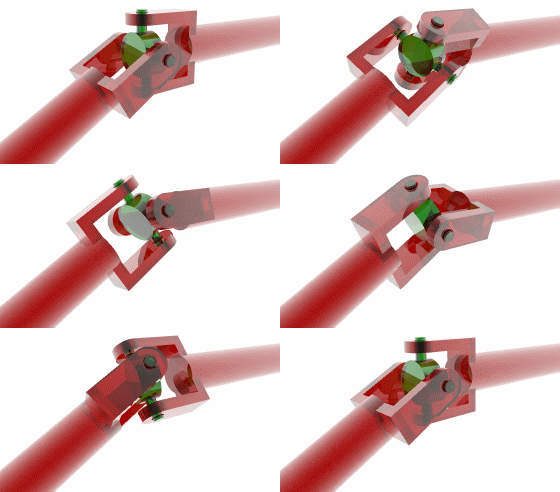
 appear, now the technic beam was not studded, it had rounded ends and could only be attached to another beam by use of a connecter pin or axle. A technic beam also has a aspect ratio of 1:1, where as a technic brick's aspect ratio was 6:5. Technic beams were used in combination with bricks for a few ye.    ars after their development, designers eventually started using beams more the bricks. As beams provided more versatility. Fiber Optics were also introduced in 1996 to simulate the flow of energy, such as spark plugs to a motor, or turn signals. According to Bricklink fiber optics were only used in 2 sets in 1996, and never appeared in Another technic set. 1997 saw the introduction of a barcode reader, also known as code pilot (Fig 7.), 
Fig 7.
this barcode reader only appeared in set 8479, Lost_In_Noise made a wonderful review of set 8479, including some insightful details into the operation of the code pilot. Angle connectors (Fig 8.) 
Fig 8.
were also introduced in 1997, each angle connector is offset from the next by 22.5 Degrees, These connectors are 1-6 from left to right. Until next time, remember if you can dream it, you can build it. I hope to have the next 10 years of history posted within 2 weeks time. There’s so much information to find, and put together. I’d like to thank Bricklink, Brickset, Eurobricks, Brickfactory, for information, pictures, catalog images, and pictorial reviews

Sunday, January 10, 2016

First external Forum link

     To many, it's just a Forum post, but to me, It's my first time being linked to an outside forum, which is a small victory to me, especially in a different language. This is the post here, and to the person who created the post, there will be plenty more history to come, it's just to much to comply into one post. That's it for now. My little celebrations over. Remember if you can dream, it you can build it.

Friday, January 8, 2016

The History of Lego Technic 1977-1987 Part 1

Fig 1.
Fig 2.
     Before we start, I would like to say that I will be breaking down the history into chunks, all links can be found at the bottom of this page when all posts are wrote, 38 years of history over four posts. Lego Technic spurred from Lego in 1977 under the name, Expert Builder, or Technical Sets, in 1982 and 1986 the line was renamed Technic. According to Brickset.com, there are currently 273 sets, not counting supplementary sets, and accessory packs. That number is forever changing as every year Lego releases a new batch of Technic sets. The sets are designed 2-3 years in advance to being released, so a set that was released in 2015 got its concept in 2012-2013. In 1977, Lego released what were called "Technical Sets" in Europe; this new line of Lego's was aimed for older children in their teenage years. In 1978 "Expert builder" sets were released in the U.S, both lines are the same sets just under different names; both launches consisted of four models and two supplementary sets. In Fig 1. We see the original Technic elements, some bricks with holes for axles and pins; at the bottom middle, we see a 40-tooth gear, a 24-tooth gear and a 24-tooth crown gear. The crown gear was later replaced by bevel gears, which didn't come along until 1995. In 1979 Lego released its first motorcycle along with its first bulldozer and 6 more supplementary sets, set 951 (Fig 2.) which featured lifting and tipping of a bucket, treads running on 40 tooth gears. The 12-volt motor was also introduced in 1979, it used the same transformer as the 12-volt train motors. In 1980 the 8858, and 8860, were released, both sets were designed to allow the builder to build different designs of their choice. The 8888 expert builder book was also released in 1980. In 1981 five sets and one accessory set were released; 8710, accessory set, 8844, 8845, 8846, 8848, 8859. 1982, the technic year, Lego changed the name of these sets from Expert Builders and Technical sets to Technic in continental Europe, the name was not changed in the USA until 1986, even with the long time between the two continents name change,  The name Technic has held firm ever since. 1982 also saw the introduction of a 4.5 volt motor set, the Friction connector was also introduced, also known as a pin, it became one of the most valued pieces in all of the technic line, its main purpose is to clamp attach two pieces together, by the lip on each end of the pin latching on to the outside edge of a beam or brick. Only four sets were released from the technic line in 1982, those sets were 8030, 8050, 8090, and 8700. In 1983 only three sets were released, the 1924 motorcycle which was designed as a promotional product, the 8841 desert racer, and the 8847 dragster made 1983 a small year. 1984 made up for the drop in 1983 by introducing pneumatics (Fig 3.). This was the first line of pneumatics to be used in technic. to properly set up a proper with these pneumatics one needed to connect a pump to a distribution block, now the air compressor is of course able to create compression but
Fig 3.


somehow the distribution block also creates vacuum pressure; both pressure and vacuum are transferred to a valve to choose between the two. The vacuum or pressure is then routed through the bottom port of the valve and into the only port on the cylinder. The only downside to this pneumatic setup was the cylinders could move a better amount of weight when using pressure instead of vacuum. The only two sets released in 1984 were 8851, 8843 and another idea book for pneumatics. 1985 was a very small year of the technic line as attention was focused elsewhere in the Lego group, the only set to be released was the 1972 Go-Kart. In 1986, Lego released eight set in total, two of which were supplementary packs. the sets of 1986 took on an arctic appeal, 8620, 8640, 8660, 8680, 8842, 8849, 1986 is also when we saw the premiere of technic figures, bigger than a mini figure.1987 was another small year for technic, as only one set was released the 8852 robot, as the transformer movie was released not to long before this set was released Lego tried to catch a part of the hype by creating their own transformer, there was also another idea book released in 1987. as long as this may seem it only covers a 4th of Lego’s long running history, more updates to the history of technic will come soon, until that time, remember if you can dream it you can build it.

Wednesday, December 30, 2015

Lego CVT. Continuously Variable Trasmission.


Fig 1a.
Fig 1b.

     What do you build for the person that has everything? Why a Lego CVT (continuously variable transmission) of course. This creation was originally built by Nico71, based on an idea from Zblj's work of a transmission that can constantly change between gears, thus he created a CVT. Nico expanded on the idea by adding the Tach's for motor and output speed. Fig 1a shows the rear side of the machine where all the magic takes place, two 16-24 tooth differentials are the heart of this machine. Underneath the differentials are two 24-tooth gears maintaining a ratio of 1:1.
Fig 3.
Fig 2.


     On top of the 2 differentials is an 8 tooth gear meshing with a 40 tooth gear, creating a ratio of 1:5, a pin is in place next to the 8 tooth gear with a 8 tooth gear on that pin, that prevents the top gears from turning until resistance is applied, the video clearly illustrates that at 3:00. Fig 2. shows the two tach's, created using momentum that throws the arms, which picks up the 8L axle with stop, which is connected to a  7L rack, as the arms sling out the rack is picked up, which is connected to a 12 tooth double bevel gear which turns the tach. In Fig 3. is the gearing on top of the structure for the Tach's, the motor tach and output tach are both geared up 1:1.67, which turns the L motors 270 rpms into 445 rpms on both tach’s. The video goes over some parts I might have missed here. This is the link to Nico's blog where you can find the pictures on how to build this machine. That’s all for now, remember if you can dream it, you can build it.

Wednesday, December 16, 2015

Erm..... its a teaser for today.


 Nico71 has already built one, it’s better than an automatic transmission, it’s better than a manual transmission, but less complicated. Two differentials are the heart of this machine, but in the end, what is it? What does it do? Well those are questions that will not be answered until Friday, let your minds wander, and remember if you can dream it, you can build it.

Friday, November 20, 2015

Lego Technic Racing Wheel And Phone Holder

Fig 2.
Fig 1.

  How do you prop your phone up on your desk to watch videos, surf the web, or even playing games? Why with a technic phone holder and racing wheel of course (Fig 3).
In (Fig 4) you are able to see the 1:1 ratio between the steering wheel and the axle that leads to the turntable.

Fig 3.
Fig 4.

Fig 5.
 In (Fig 1) you are able to see the axle that leads from the steering wheel over to the 60 Tooth Turntable, a 12 Tooth double bevel gear turns the turntable, creating a gear reduction of 5:1. Referring back to Fig 3, it would take 5 turns of the small steering to make one total turn of the phone carriage. The carriage is specifically designed for the Droid Turbo 2, the phone fits snug in the carriage and can even be turned upside down without the phone falling out.

Sunday, November 8, 2015

Lego Technic 42008 Pneumatic Modifcations

Fig 1.

Fig 2.

Fig 4.
Fig 3.

Fig 6.
Fig 5.
Anyone familiar with recent technic sets will recognize 42008 almost instantly; its green body is one of the most recognizable sets in the long line of technics. The 42008 featured power functions, and pneumatics, the only pneumatics in the truck were 2 1x5 cylinders and they were small and didn’t provide and power. The power functions in 42008 never seemed to do the \
Fig 8.
Fig 7.
set justice, I was itching to build it again as I loved the set, it packed plenty of functions into a body that is beautifully sculpted with panels and liftarms. I purchased an extra set of all pneumatic cylinders in set 42043 to be able to play around with, as I was building 42008 I started looking at it and said I can use the new cylinders to make a pneumatic 42008. In Fig 1. We see the air tank that holds all compressed air in the truck. There is also an onboard compressor on the truck along with a hand pump (Fig 6). Both are connected by a T-piece visible in Fig 5, while looking at Fig 5 I would like to go over the different color valve handles. The Brown handle is the master valve, pushed to the right it dumps all air from the entire system, pushed to the left it supplies the system with air, 
Fig 9.


Fig 10.

Fig 11.
Fig 12.
 System with air, the red handle, pushed to the right lowers the whole boom, pushed to the left it raises the boom (Fig 9). The black handle pushed to the right raises the tow dolly, when pushed to the left it lowers it (Fig 4). The white handle when pushed to the right retracts the arm extension, when pushed to the left it extends the arm extension (Fig 8). The yellow handle when pushed to the right retracts the rear stabilizers, when pushed to the left the stabilizers are extended (Fig 3). Figures 2,7,10,12 are skeleton pictures of the truck, showing all the hoses and cylinders, Fig 10 showcases all the functions with out the side panels on the trucks. Fig 11. Is the last picture to be discussed, it shows all the functions of the truck, but paneled over, without the panels the truck feels very empty. Below is a link to my review of 42008 without pneumatics.
     Review of Technic set 42008

Sunday, October 25, 2015

More Technic 2016 1H sets leaked

Technic 2016 2H sets can be found here.
The images below are more leaked pictures of Lego Technic 2016 1H sets (click on one to enlarge it). Set 42050 (fig 3 top) appears to be a dragster, which appears to use tumbler-tires (which appeared in set 76023). It also has a load of light blue panels and pieces, which will make MOC building better and worse.
fig 4
fig 1


fig 2
fig 3
Better for the builder and worse for the person trying to collect the parts to build it. The V8 engine also seems to be more detailed than seen in previous years. The next set is 42051 (fig 3 bottom), an airport rescue truck. the arm is fold-able, by use of a worm gear turning, most likely a 24 tooth gear, and the gear is the pivot point of the arm, is you look closely above the name airport rescue, a tan 20 tooth double bevel gear can be spotted, either for arm folding or HOG (hand of god) steering. The red is a welcome color to me, even though most of it is panels. Two red flexible axles are used to shape the cab; nothing else can really be noticed in 42051 except the odd use of balloon tires, instead of typical road tires. In fig 2, we see the latest helicopter that created quite a buzz, due to its coaxial rotors, in the picture we can also see that it is power functions equipped, or ready for power functions. doing a quick stud count using panels, this set will be the biggest of the 1H sets for 2016, if you zoom in on fig 2, just above the IM in image there looks to be a red changeover catch, indicating a gearbox in the helicopter for functions such as; rotors, landing gear, opening cargo bay door, and winch. In addition to, if you look at the base of the rotors there is one small turntable to hold both rotors to the helicopter. In fig 4, we see the 42044 jet in the top left corner, it looks to be an ordinary jet, and nothing special can be seen when looking at the jet, just a bunch of panels covering a small shell.


Friday, October 23, 2015

Technic 2016 1H sets

fig 1. 42045
fig 4. 42048
fig 3. 42047

fig 5. 42049
fig 2. 42046
Every year LEGO releases a new line of sets, in two batches, 1H and 2H. 1H sets have always been released in January, while 2H sets have always been released in august. The five figures shown are the only sets that have been leaked by Lego. In (fig 1.) we can see the new hydroplane racer, with a body that looks to be manly comprised of panels, give it a sleek and flowing look. The only noticeable new item is the technic curved panel 1x13 in light blue, across the back of the racer. The hydroplane racer also sports a massive I4 (inline 4) engine. In (fig 2.) we see the 42046 getaway racer, featuring gold rims, and a pullback motor. No new molds or colors of molds can be seen on the 42046. I should note that since these pictures are first leaked images, the resolution is small, and the picture is not accurate of the final design, the final design has been known to change when released to stores. The next new set (fig 3.) is the police interceptor, built more like an off-road vehicle, for off road chases, lime accents, a bright white body, and a red and blue beacon on top of the car, give it a brilliant look that next to the getaway racer will stand out brilliantly against its black, and smoke gray colors. This set also has a pullback motor in it, up until now the two pullback sets for each year have had a duality of on road/off-road. This year one could say it is a cops and robbers showdown between the pullbacks. in (fig 4.) we see a race kart, or go kart, many have said that the red handle next to the seat might be a handbrake, but if we look on the other side of the seat, we can see part of a 1x9 technic link (fig 6. at bottom of page) which must be connected to the rear engine module. If you look carefully inside the module, next to the wheel, you can see a red clutch gear, Indicating a gearbox inside the rear of the go-kart, which is most likely used to change the engine speed. The only new item I can spot is the technic curved panel 1x13 in purple. The last picture shown (fig 5) is 42049, which is also called a mine loader, rides on 62.4 mm wheels, same wheels used in 42009, 42043, and other various sets. The mine loader has a low profile to allow it to work in the tight spaces of a coal/ diamond, anything mine. There is a grabber claw on the front of the loader, making it more of a handler, then loader. There are more sets to be released, (see list below, clicking on the set will take you to the Brickset page for it) but pictures are not available for those sets. It was hard to get my hands on these. Lego is not too happy when there pictures are leaked. There is also a theory that the pictures are intentionally leaked in order to create hype among the Lego community.